The Truth Most Parents Get Wrong About Teenage Boys
Let’s start with a hard truth.
Most parents believe that when boys enter puberty, they become rude, distant, or careless.
This belief is not only inaccurate; it is harmful.
Because what appears as “attitude” is often a deep internal shift that boys themselves don’t fully understand.
Boys are not pulling away to reject you. They are pulling inward to figure themselves out.
If you misinterpret this silence, you may respond with control, frustration, or criticism. And that is exactly what pushes them further away.
If you understand it, however, you protect something far more important than daily conversations you protect long-term trust.
What Actually Happens to Boys During Puberty
Their Brain Is Rewiring, Not Just Their Bodies
Puberty is not only physical. It is neurological.
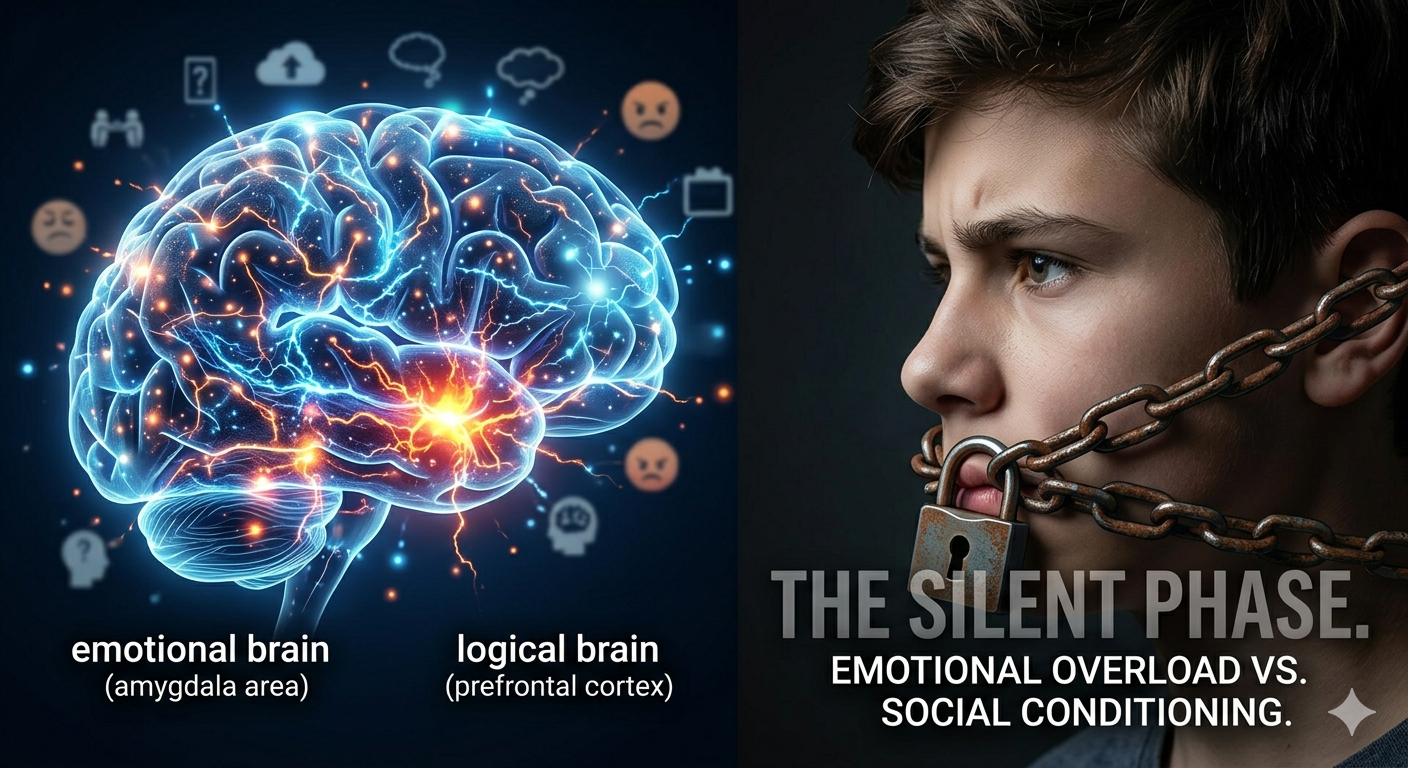
During this phase, the emotional part of the brain develops faster than the logical part. This means boys feel intense emotions but cannot express or regulate them effectively.
They may feel:
-
Confusion
-
Pressure
-
Self-doubt
-
Irritation without clear reasons
But when asked what’s wrong, the answer is often:
“Nothing.”
Not because nothing is happening, but because they cannot articulate it.
This is where many parents misjudge the situation.
Your son is not hiding things deliberately. He is still learning how to understand what is happening inside him.
Boys Are Socially Conditioned to Suppress Emotions
From a young age, boys receive subtle but powerful messages:
-
Be strong
-
Don’t cry
-
Handle it yourself
Over time, they internalize the idea that expressing emotions is a weakness.
So when puberty amplifies their emotional world, they do not express more—they express less.
Silence becomes their safest option.
This is not a personality flaw. It is a learned survival strategy.
Identity Development Happens Quietly
During puberty, one major psychological process begins: identity formation.
Your son is trying to answer questions like
-
Who am I?
-
How do others see me?
-
Where do I fit?
This internal questioning takes energy, attention, and space.
It often shows up as withdrawal.
Parents may see disengagement. But what is happening is deep internal processing.
The Need for Independence Increases
As boys grow, their need for independence becomes stronger.
They start pulling away from parental control not because they don’t value the relationship, but because they are trying to develop autonomy.
This is a natural and necessary step.
However, when parents respond by tightening control, it creates resistance instead of connection.
Where Parents Often Go Wrong
Taking Silence Personally
One of the most common mistakes parents make is assuming the following:
“He doesn’t talk to me anymore because something is wrong between us.”
In most cases, this is not true.
The change is developmental, not relational.
But when parents take it personally, their behavior changes. They may become more critical, more emotional, or more controlling,all of which push the child further away.
Forcing Communication
Parents often believe that more talking will solve the problem.
They initiate serious conversations, ask repeated questions, or demand explanations.
This approach rarely works with teenage boys.
Pressure creates shutdowns.
The more you push, the more they retreat
Overreacting to Small Disclosures
When a boy finally opens up and shares something, the parent’s reaction is critical.
If the response includes:
-
Immediate judgment
-
Anger
-
Lecturing
The child learns one thing very quickly: it is not safe to share.
And next time, he won’t.
Mislabeling Behavior
Words like “lazy,” “rude,” or “careless” are often used to describe teenage boys.
But these labels miss the underlying reality.
Behavior is communication.
And when you label instead of understanding, you lose the opportunity to respond effectively.
What Smart Parents Do Differently
They Create Low-Pressure Opportunities for Connection
Teenage boys rarely open up during formal conversations.
They talk when the environment feels relaxed and non-threatening.
This often happens during:
-
Car rides
-
Casual walks
-
Shared activities
-
Late-night quiet moments
In these situations, eye contact is reduced, pressure is low, and communication feels natural.
Smart parents understand that connection is not built through scheduled talks,it is built through shared presence.
They listen without trying to fix immediately.
When a boy speaks, most parents instinctively move into problem-solving mode.
They correct, advise, or analyze.
But what boys need first is to feel heard.
Listening without interruption or immediate correction creates emotional safety.
Emotional safety leads to more communication.
They regulate their own reactions.
A parent’s emotional response shapes the entire communication dynamic.
If a child expects anger or disappointment, he will avoid sharing.
If he expects calmness and understanding, he will gradually open up.
This does not mean you ignore problems.
It means you manage your reaction so that communication remains open.
They Respect Space Without Disconnecting
There is a difference between giving space and becoming distant.
Smart parents allow independence while maintaining emotional availability.
They do not hover, but they remain present.
They send a consistent message:
“I trust you, and I am here when you need me.”
They Adapt Their Parenting Style
One of the biggest mistakes parents make is using the same approach they used when the child was younger.
Teenagers require a different style.
Less control.
More guidance.
Less instruction.
More conversation.
Parenting during puberty is not about authority—it is about influence.
Expert Insight Most Parents Overlook
The real issue is not that boys have stopped talking.
The issue is that parents continue to use communication styles that no longer work.
If you approach a teenager the same way you approach a child, you will face resistance.
But when you adjust your approach, something shifts.
Communication returns, not because you forced it, but because you made it safe.
A Real-World Perspective
As a school leader working closely with students, I have observed a consistent pattern.
Boys who are labelled as “quiet” or “disengaged” are often the ones processing the most internally.
In environments where they are pressured, they withdraw further.
But when given space, respect, and calm guidance, they begin to participate again.
This shift does not require complex strategies.
It requires understanding.
And when parents adopt this mindset, the impact is visible not only in behavior but also in confidence and connection.
Conclusion:
Your son is not becoming distant.
He is becoming private.
And there is a difference.
If you misinterpret his silence, you may respond in ways that close doors.
But if you understand it, you create a relationship where he feels safe,even in his most confusing phase.
This stage will pass. But the way you handle it will define your relationship for years to come.
FAQ
Why do boys become quiet during puberty?
Boys become quiet because they are experiencing emotional, hormonal, and psychological changes that they do not fully understand or know how to express. Silence becomes a coping mechanism rather than a sign of rejection or disinterest.
Is it normal for my son to avoid talking to me?
Yes, it is normal. During puberty, boys seek independence and may reduce communication as part of their development. However, maintaining a supportive and non-judgmental presence helps preserve connection.
How can I reconnect with my teenage son?
Reconnection happens through small, consistent actions. Reduce pressure, create relaxed environments for interaction, listen without judgment, and respond calmly. Over time, this builds trust and encourages communication.